AI Search Optimization
Knowledge Graph for Local Businesses
Learn how a knowledge graph helps local businesses become easier for Google, Maps, and AI search systems to understand, trust, and surface.
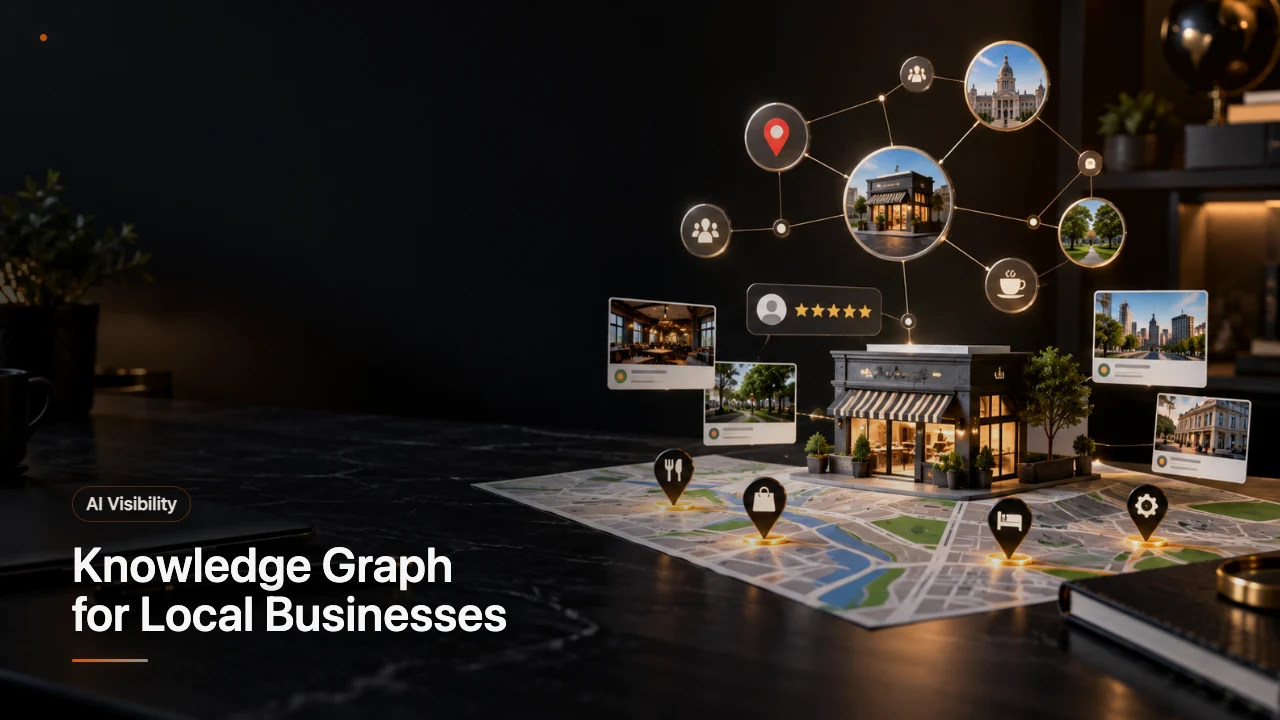
Table of contents
Quick answer
Learn how a knowledge graph helps local businesses become easier for Google, Maps, and AI search systems to understand, trust, and surface. This article explains the practical impact for businesses in Pakistan and the decisions to review before investing more budget into ai search optimization or paid growth.
Key takeaways
What you should know before acting
What A Knowledge Graph Means For A Local Business
Knowledge Graph Vs Business Profile Vs Local SEO
Why Local Businesses Lose Entity Clarity
Many local businesses think they have a rankings problem when they actually have an identity problem.
Google sees one business name on the website, a shorter version on the Google Business Profile, an old phone number in directories, a founder page with no role clarity, and service pages that never clearly explain where the business operates.
Then the owner asks a fair question:
Why are we not showing up more consistently in Search, Maps, and AI answers?
Because search systems do not reward confusion.
They reward clarity.
And clarity, in 2026, is increasingly shaped by the quality of your business knowledge graph.
Introduction
A knowledge graph for local businesses is the connected set of facts and relationships that help search engines and AI systems understand your business as a real entity.
That includes basics like your business name, website, phone number, location, service area, and opening hours. But it also includes relationships: which founder is associated with the company, which services belong to the business, which pages explain those services, which citations support the address, which reviews validate customer experience, and which images, profiles, and references point back to the same organization.
This is why local visibility is no longer just about adding keywords to a page.
It is about reducing ambiguity.
Google itself says knowledge panels are generated automatically from information available on the open web, and that local businesses should manage their presence through Google Business Profile. Google Search Central also says Organization and LocalBusiness structured data can help Google understand administrative details, business facts, and local information more clearly.
That does not mean schema alone creates a knowledge panel.
It means your business becomes easier to classify, corroborate, and trust when the same facts show up consistently across the places Google already relies on.
For local businesses, that is the real job.
The Short Answer
If you want the simplest version, here it is:
A local business knowledge graph is the web of confirmed facts that tells search engines and AI systems:
- who your business is
- where it is located
- what it offers
- who is behind it
- how people can contact it
- which sources confirm that information
When those facts are consistent, your business becomes easier to trust and easier to surface.
When they conflict, visibility becomes weaker across:
- branded search
- Google Maps
- local pack results
- knowledge panels or business panels
- AI-generated answers that need grounded business information
So the goal is not to "hack the Knowledge Graph."
The goal is to make your business identity easier to understand everywhere it appears.
What A Knowledge Graph Means For A Local Business
The phrase "knowledge graph" can sound abstract, but for a local business it is practical.
Think of it as a network.
In that network:
- the business is an entity
- the founder or leadership team are entities
- the office or service area is an entity
- the services are entities
- the website pages that explain those services are evidence nodes
- the Google Business Profile is a major trust source
- citations, directories, reviews, and social profiles are supporting confirmations
When Google or another system encounters your brand, it is trying to connect these dots into one stable understanding.
That understanding powers things like:
- whether your site seems like the official website
- whether your local information looks trustworthy
- whether branded searches return a strong business panel
- whether service pages are interpreted as belonging to the same organization
- whether AI systems can confidently mention your business in local or service-related answers
The business-understanding layer
This is the layer many businesses skip.
They publish a homepage, maybe a contact page, maybe a Google Business Profile, and assume the rest will sort itself out.
Sometimes it does.
But in competitive categories, weak entity clarity becomes expensive. If a clinic has multiple name variants, outdated practitioner data, incomplete service pages, and mixed address signals, Google has to work harder to figure out what is true. That uncertainty reduces confidence.
Confidence matters because local search is partly a retrieval problem and partly a trust problem.
Knowledge Graph Vs Business Profile Vs Local SEO
These terms overlap, but they are not identical.
| Concept | What It Is | What It Does |
|---|---|---|
| Knowledge graph | The network of facts and relationships about your business | Helps systems understand the entity behind the website and profile |
| Google Business Profile | Your managed business listing on Google Search and Maps | Provides verified local business details, reviews, hours, categories, and media |
| Local SEO | The broader discipline of improving local discovery and conversions | Covers rankings, service pages, reviews, citations, content, links, and technical clarity |
| Structured data | Machine-readable markup on your site | Gives explicit clues about the organization, location, and page content |
The cleanest way to think about it is this:
Local SEO is the strategy.
Google Business Profile is one of the strongest local assets inside that strategy.
Structured data is one support layer.
The knowledge graph is the business-understanding outcome produced when those signals align well enough.
Why Local Businesses Lose Entity Clarity
Most local businesses do not have one big knowledge graph issue. They have ten small inconsistencies that compound.
1. Brand naming drift
The business name on the homepage says CREA8IV MEDIA MARKETING AGENCY (PRIVATE) LIMITED, the footer says CREA8IV MEDIA, directories use Crea8iv Media Agency, and the Google Business Profile shows something slightly different again.
Some variation is natural.
Too much variation creates ambiguity.
2. Weak location proof
The business says it serves Rawalpindi and Islamabad, but there is no strong contact page, no location references on service pages, and no visible business details tied together in structured data.
3. Thin service pages
If you offer local SEO, Google Ads, web design, and AI automation, but the site only explains them at a high level, it is harder for systems to connect those services with the business entity in a precise way.
4. Inconsistent citations
One directory has the old phone number. Another uses an old address. Another has an outdated website URL. Those small mismatches weaken corroboration.
5. Missing people-entity clarity
Founder, owner, or leadership pages often matter more than businesses realize. A credible founder profile helps connect the business to a real operator, real expertise, and a clearer authorship layer.
6. Generic content with no local anchors
A page about "SEO services" is weaker than a page that clearly explains the business, target market, location context, case patterns, and service relevance for local customers.
The Signals That Build A Stronger Local Knowledge Graph
Google's own documentation points to several major business-understanding inputs: official website details, Business Profile data, structured data, and information available across the web. For local businesses, the strongest version of that usually includes the following.
1. A clearly established official website
Google Search Central says the first step in establishing your website as an official presence is verifying it in Search Console. That matters because it helps Google associate ownership, sitemaps, crawl access, and site-level trust signals with the real business.
Your site should make these facts easy to find:
- official business name
- primary phone number
- address or clear service area
- official domain
- contact email
- consistent brand description
2. A complete and actively managed Google Business Profile
Google's business details guidance is direct: local businesses that serve customers at a location or within a service area should claim and manage their Business Profile.
This is not optional if local visibility matters.
A strong profile reinforces:
- primary category
- secondary categories
- opening hours
- location or service area
- photos
- products or services
- review activity
- business description
It also helps distinguish a local business panel from broader knowledge panel behavior. Google explicitly notes that local businesses use Business Profile for Search and Maps presence.
3. Organization and LocalBusiness structured data
Google says Organization markup helps it understand administrative details and disambiguate the organization in search results. It also says LocalBusiness structured data can describe business hours, location details, and other local facts.
This matters because structured data is not magic, but it is clean evidence.
Good markup can reinforce:
- official name
- URL
- logo
- address
- telephone
- contact points
- opening hours
- sameAs references
- business type
4. Strong internal entity relationships
Your site should not feel like isolated pages.
The homepage, service pages, about page, founder page, blog content, contact page, and local pages should support one another. If a founder page discusses AI search optimization and local SEO, it should link to those service pages. If the service pages explain business visibility, they should link back to relevant guides and the founder or company context where helpful.
That is not just internal linking for SEO.
It is internal linking for understanding.
5. Supporting citations and third-party consistency
Google's knowledge panel help explains that knowledge panels draw from information available across the web. That means your website is not the only source that matters.
Supporting sources often include:
- reputable directories
- social profiles
- map listings
- press mentions
- review platforms
- authoritative partner or association pages
The job is not to be everywhere.
The job is to be consistent where you are.
6. Visible trust signals
For local businesses, trust signals often determine whether entity understanding turns into actual visibility and conversions.
Useful trust signals include:
- real team or founder identity
- photos of the office, team, or work
- service-specific proof
- customer reviews and reputation signals
- clear pricing or pricing approach where appropriate
- policies, legal pages, and contact accessibility
A Practical Framework For Local Businesses
Here is a usable framework local businesses can apply without overcomplicating the work.
Step 1. Choose the canonical facts
Before you optimize anything, lock down the exact facts you want every important source to reflect.
Use one source-of-truth list for:
- business name
- short brand name if used publicly
- address
- phone number
- domain
- service areas
- core categories
- founder or director name
- social profile URLs
If these are not documented, teams drift.
Step 2. Fix the official website first
Your site should confirm the entity clearly.
Start with these pages:
- homepage
- about page
- contact page
- main service pages
- founder or leadership page
Check whether each page reinforces the same story.
Step 3. Align the Google Business Profile
Make sure the profile matches the website closely enough on the core facts that matter:
- name
- contact data
- categories
- location or service area
- service descriptions
- media
You do not need every word to be identical.
You do need the business identity to be unmistakably the same.
Step 4. Add or refine structured data
Use Organization markup on the most relevant official page and LocalBusiness markup where appropriate for the location or business details. Keep it accurate and visible. Google's guidelines are clear that structured data should match the content users can actually see.
Step 5. Strengthen corroboration sources
Update the local citations and business references that matter most.
Prioritize accuracy over volume.
Ten strong, consistent references are more useful than fifty weak ones.
Step 6. Publish entity-supporting content
This is where many businesses miss easy wins.
Good content can help clarify:
- what the business does
- who it serves
- where it operates
- how its services differ
- who leads it
- which related topics it has authority in
That content can include:
- service explainers
- local guides
- category comparison pages
- founder authority pages
- FAQ pages
- case studies
Step 7. Review for contradictions
Before you call the system clean, actively look for conflicts.
| Area | What To Check | Why It Matters |
|---|---|---|
| Name | Business name variants | Too many variants create entity ambiguity |
| Location | Address and service area consistency | Local trust weakens when location facts conflict |
| Contact | Phone and email consistency | Mismatches reduce confidence and conversions |
| Services | Same service story across pages and profiles | Helps systems connect the right intent to the right entity |
| People | Founder, ownership, and authorship clarity | Supports EEAT and person-organization relationships |
| External references | Directory and profile accuracy | Corroborates website claims |
Examples For Clinics, Restaurants, And Service Brands
Example 1. A dental clinic
A clinic wants stronger visibility for cosmetic dentistry and dental implants.
Weak setup:
- homepage mentions only "dental services"
- Business Profile category is too broad
- doctor pages are thin or missing
- citations use old address data
- no treatment-specific service pages
Stronger knowledge graph setup:
- the site clearly identifies the clinic brand, address, phone number, and doctors
- treatment pages explain implants, braces, whitening, and emergency care separately
- doctor biographies support people-entity trust
- Business Profile categories and services align with the site
- review language and local references reinforce treatment relevance
The result is not just better SEO copy.
It is stronger business understanding.
Example 2. A restaurant
A restaurant wants to appear more reliably for branded search, maps discovery, and local dining intent.
Weak setup:
- menu lives only on Instagram
- website has no consistent opening hours
- address formatting differs across platforms
- Google profile has weak image coverage and outdated business details
Stronger setup:
- website shows official location, contact details, hours, menu highlights, and reservation path
- Business Profile matches the same core facts
- local citations use the same address and phone
- structured data supports restaurant identity and contact details where relevant
- review signals and fresh photos strengthen the real-world trust layer
Example 3. A local service brand
A digital agency, law firm, salon, architect, or repair company often serves more than one area and struggles with scattered positioning.
Weak setup:
- generic homepage
- unclear service-area footprint
- no founder page
- services mixed together with little specificity
- inconsistent branding across directories
Stronger setup:
- clear service categories
- one strong contact/location page
- founder or leadership page tied to the brand
- city or service-area references where truthful and useful
- internal links between service pages, educational articles, and contact paths
That is how a business becomes easier to parse both for human buyers and for retrieval systems.
Common Mistakes That Weaken Local Trust
Treating schema as the whole strategy
Schema helps.
Schema alone does not fix business confusion.
If the visible content is weak, the citations are messy, and the Business Profile is under-managed, markup will not rescue the outcome.
Creating location claims without real support
If a business says it serves ten cities but has no meaningful proof, no useful local context, and no operational reality behind those claims, that can backfire.
Local authority should be built on truth, not expansion fantasies.
Ignoring the founder or operator layer
For many local businesses, especially service businesses, the company is partially trusted because the person behind it is trusted.
If the leadership layer is invisible, one useful trust bridge is missing.
Publishing disconnected content
Local businesses often publish blog posts that never tie back to services, geography, people, or conversion paths. That content may exist, but it does not reinforce the entity graph well.
Letting old data stay live
Old phone numbers, retired locations, stale hours, or merged brands create one of the most common local trust problems. Systems remember what the web keeps repeating.
Knowledge Graph Checklist For Local Businesses
- Use one canonical version of your business name and core contact details.
- Make the official website easy to identify and verify in Search Console.
- Claim and actively manage the Google Business Profile.
- Keep address, phone, business category, and operating details consistent across important sources.
- Add accurate Organization and LocalBusiness structured data where relevant.
- Build strong About, Contact, and service pages.
- Publish a credible founder or leadership page if the business trust model benefits from it.
- Add internal links that connect the business, people, services, and educational content.
- Update important citations and remove outdated directory data.
- Keep reviews, photos, and real-world trust signals fresh.
- Treat entity clarity as an ongoing maintenance task, not a one-time setup.
Actionable Takeaways
If you want the highest-leverage next actions, start here:
1. Audit your top ten public business references for name, address, phone, and URL consistency. 2. Compare your homepage, contact page, and Google Business Profile line by line for mismatched facts. 3. Strengthen the relationship between your business page, service pages, and founder or team page. 4. Add or refine Organization and LocalBusiness markup so it supports visible business details accurately. 5. Publish content that helps explain your category, location relevance, and service expertise in plain language.
FAQ
What is a knowledge graph for a local business?
It is the network of facts and relationships that helps search engines and AI systems understand your business as a real entity. That includes your name, website, location, services, contact details, people, and supporting references across the web.
Is a Google Business Profile the same thing as a knowledge graph?
No. A Google Business Profile is one major source of business data for local visibility in Google Search and Maps. A knowledge graph is broader and includes website content, structured data, citations, relationships, and corroborating facts from across the web.
Does structured data guarantee a business knowledge panel?
No. Google does not guarantee that correct structured data will appear as a visible search feature. Structured data helps clarify facts, but it works best as part of a wider entity and local SEO system.
Can small businesses benefit from knowledge graph strategy, or is this only for big brands?
Small businesses can benefit a lot because local markets often depend on trust, clarity, and category understanding. A cleaner entity footprint can improve branded search, Maps confidence, and the consistency of business information across search surfaces.
Why do founder or team pages matter for local entity SEO?
They help connect the business to real people, real expertise, and accountable leadership. That can strengthen trust, authorship clarity, and person-organization relationships, especially for expert-led service brands.
What usually causes entity confusion for local businesses?
The most common causes are inconsistent names, old phone numbers, outdated addresses, thin location proof, weak About or Contact pages, and profiles or directories that do not match the official website.
Does a knowledge graph matter for AI search too?
Yes. AI systems work better when they can ground answers in clear entities and consistent facts. If your local business is easy to understand across your site, profile, citations, and content, it becomes easier for answer systems to retrieve and represent accurately.
Conclusion
The future of local visibility is not only about who publishes the most pages or repeats the most keywords.
It is about who becomes easiest to understand.
That is what a knowledge graph does for a local business.
It turns scattered facts into a coherent identity.
When your business name, website, founder, contact details, service pages, local references, structured data, and Business Profile reinforce one another, search systems have less reason to hesitate.
That makes rankings more defensible, branded discovery stronger, Maps visibility clearer, and AI-driven business understanding more accurate.
In a crowded local market, that clarity is not a technical extra.
It is a competitive advantage.
Execution path
How to use this guide
Audit
Check the current page, search result, and conversion path.Find the exact gaps before changing budgets, copy, design, or publishing frequency.
Fix
Upgrade the offer, structure, tracking, and trust signals.Make the page easier to understand, cite, compare, and act on from mobile.
Scale
Connect the article to Ai Search Optimization.Use the content as a practical entry point into a service, tool, or booked conversation.
Useful links
Continue through the right pages
FAQ
Frequently Asked Questions
What is a knowledge graph for a local business?
It is the network of facts and relationships that helps search engines and AI systems understand your business as a real entity. That includes your name, website, location, services, contact details, people, and supporting references across the web.
Is a Google Business Profile the same thing as a knowledge graph?
No. A Google Business Profile is one major source of business data for local visibility in Google Search and Maps. A knowledge graph is broader and includes website content, structured data, citations, relationships, and corroborating facts from across the web.
Does structured data guarantee a business knowledge panel?
No. Google does not guarantee that correct structured data will appear as a visible search feature. Structured data helps clarify facts, but it works best as part of a wider entity and local SEO system.
Can small businesses benefit from knowledge graph strategy, or is this only for big brands?
Small businesses can benefit a lot because local markets often depend on trust, clarity, and category understanding. A cleaner entity footprint can improve branded search, Maps confidence, and the consistency of business information across search surfaces.
Why do founder or team pages matter for local entity SEO?
They help connect the business to real people, real expertise, and accountable leadership. That can strengthen trust, authorship clarity, and person-organization relationships, especially for expert-led service brands.
What usually causes entity confusion for local businesses?
The most common causes are inconsistent names, old phone numbers, outdated addresses, thin location proof, weak About or Contact pages, and profiles or directories that do not match the official website.
Does a knowledge graph matter for AI search too?
Yes. AI systems work better when they can ground answers in clear entities and consistent facts. If your local business is easy to understand across your site, profile, citations, and content, it becomes easier for answer systems to retrieve and represent accurately.
What this means for your business
Are your public records describing the same business?
Compare the business name, contact details, address and service descriptions across owned pages and verified profiles. Correct contradictions before adding more markup.
A schema identifier is not a guaranteed knowledge panel. Do not join unrelated entities with sameAs merely to imply association.
HN Architects documents service, location and entity-information work. The account does not establish that a knowledge panel or AI recommendation was obtained. Read the Hassan Nawaz Architects case study.
For planning consistent business information, explore Syed Qamar Abbas's SEO and AI search consulting.
Editorial decision note added by Crea8iv Media. Founder relationship.
Related Articles