AI Search Optimization
The Future of AI Search in 2026
Learn how AI search is changing SEO, rankings, citations, and leads in 2026, and how businesses can prepare for Google AI, ChatGPT, Gemini, Claude, and Perplexity.
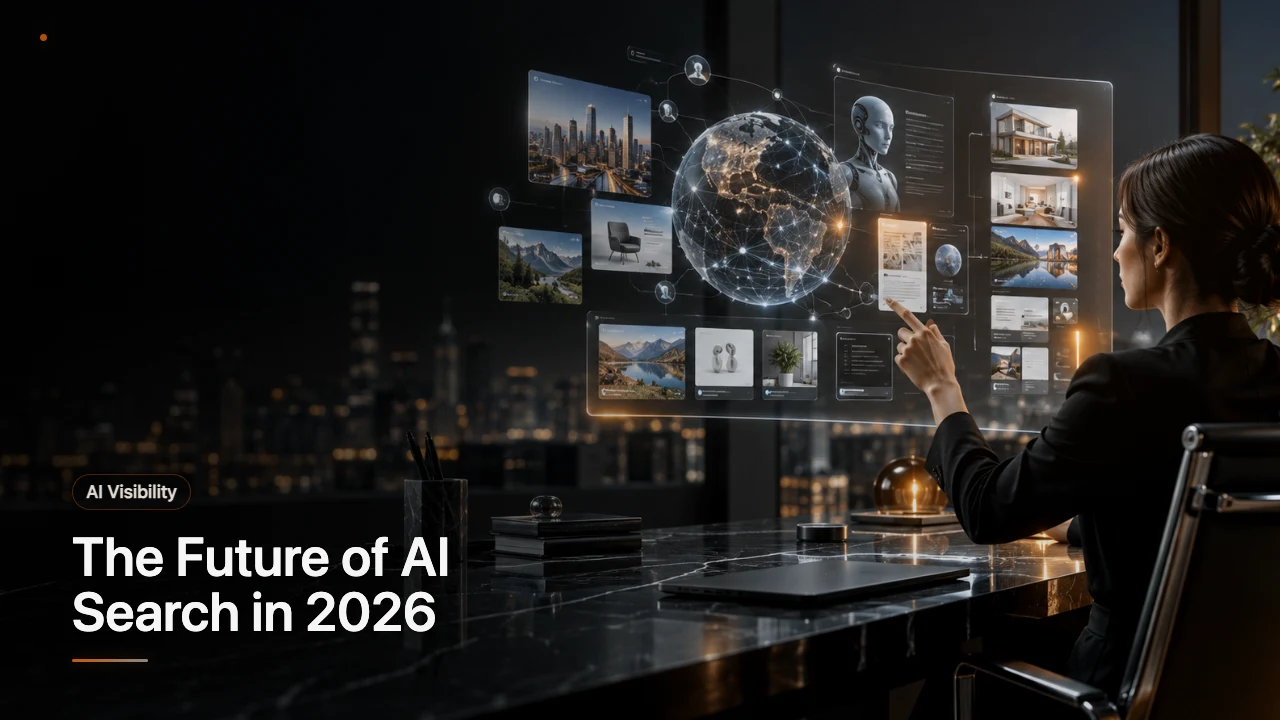
Table of contents
Quick answer
Learn how AI search is changing SEO, rankings, citations, and leads in 2026, and how businesses can prepare for Google AI, ChatGPT, Gemini, Claude, and Perplexity. This article explains the practical impact for businesses in Pakistan and the decisions to review before investing more budget into ai search optimization or paid growth.
Key takeaways
What you should know before acting
What AI Search Means in 2026
Why AI Search Is Different From Traditional Search
The Platforms Shaping AI Search
AI search is not a future trend anymore. It is already changing how people find businesses, compare options, ask follow-up questions, and decide who to trust.
In 2026, a customer may not search "best website development company" and scan ten blue links. They may ask Google AI Mode, ChatGPT Search, Gemini, Claude, or Perplexity: "Which agency can build a fast custom website and also handle SEO for a local service business?" The answer may summarize several sources, cite only a few websites, include local context, compare options, and guide the user toward the next action.
That shift changes the job of SEO.
SEO still matters. Google has made it clear that its generative AI features are rooted in core Search ranking and quality systems. But ranking is no longer the whole game. The new game is being found, understood, trusted, extracted, cited, and chosen across search engines, answer engines, AI assistants, and agentic workflows.
For CREA8IV MEDIA, this is the moment where SEO, technical SEO, semantic SEO, entity SEO, GEO, AEO, LLMO, SXO, CRO, structured data, and brand authority stop being separate tactics. They become one operating system for digital visibility.
Introduction
This guide explains what AI search means for businesses in 2026, how it changes SEO strategy, which platforms matter, what still works from traditional SEO, what is new in GEO, AEO, and LLMO, and how CREA8IV MEDIA can turn this shift into qualified visibility and leads.
What AI Search Means in 2026
AI search is the use of artificial intelligence to understand a user's question, retrieve relevant information, synthesize an answer, and often cite supporting sources. Instead of simply returning a list of pages, AI search engines try to complete more of the research process inside the search experience.
That does not mean websites disappear. It means websites have to work harder to become the source behind the answer.
In 2026, AI search commonly includes:
- AI-generated summaries in Google AI Overviews
- Conversational follow-up journeys in Google AI Mode
- Web-backed answers in ChatGPT Search
- Citation-rich answers in Perplexity
- Multimodal search using text, images, voice, video, and files
- AI assistants that compare businesses, summarize reviews, and recommend next steps
- Agentic search workflows where the system performs multi-step research on behalf of the user
Google's own documentation says AI Overviews and AI Mode surface links to help people find information quickly and explore content they may not have discovered before. Google also explains that these AI features can use query fan-out, where multiple related searches are issued across subtopics and data sources to build a richer answer.
For businesses, this means one page is not competing for one keyword anymore. One strong page may need to answer a cluster of related questions, support multiple intents, and provide enough clarity for both humans and AI systems to understand its value.
Why AI Search Is Different From Traditional Search
Traditional search was mostly a ranking interface. A user typed a query, Google returned results, and the user clicked a page.
AI search is a reasoning and answer interface. A user asks a question, the system interprets the task, searches or retrieves information, summarizes it, cites sources, and invites follow-up questions.
That difference creates a new visibility model.
| Search Model | Traditional SEO | AI Search Optimization |
|---|---|---|
| Primary goal | Rank higher on search result pages | Become a trusted source in AI-generated answers |
| User behavior | Search, scan, click, compare | Ask, receive summary, follow up, verify sources |
| Content format | Pages optimized around keywords | Extractable answers, entities, evidence, examples, tables |
| Authority signal | Backlinks, relevance, technical health | Rankings plus citations, entity clarity, source quality, mentions |
| Measurement | Rankings, clicks, impressions | Citations, mentions, AI referrals, assisted conversions |
| Risk | Losing rankings | Being invisible even when your page exists |
The key shift is simple: AI systems do not only evaluate whether a page exists. They evaluate whether a passage is useful enough to include in an answer.
That is why vague content fails. A page can be indexed, technically healthy, and still be useless to an AI answer engine if it does not provide direct definitions, clear comparisons, evidence, specific examples, and trustworthy claims.
The Platforms Shaping AI Search
The future of AI search is not controlled by one platform. Businesses need to understand how the major systems behave because each one creates different visibility opportunities.
Google AI Overviews and AI Mode
Google AI Overviews provide AI-generated summaries on search results pages, with links for deeper exploration. Google says there are no special technical requirements beyond being indexed, eligible to appear in Search, and eligible to show a snippet. That matters because it confirms a practical point: AI search visibility on Google starts with strong SEO fundamentals.
Google AI Mode goes further. It supports more exploratory, conversational searches where users can ask complex questions and continue the journey through follow-ups. In 2026, Google has also emphasized richer linking, original content, perspectives, and preferred sources inside AI search experiences.
For businesses, Google AI visibility depends on three layers:
- Technical eligibility: crawlable, indexable, fast, mobile-friendly pages
- Content quality: helpful, reliable, people-first information
- Entity authority: clear brand, service, author, location, and topical signals
ChatGPT Search
ChatGPT Search gives users timely answers with links to relevant web sources. OpenAI's help guidance says public websites can appear in ChatGPT search and that publishers should avoid blocking OAI-SearchBot if they want their content discovered, surfaced, summarized, and cited.
This creates a technical SEO requirement many businesses still miss. A company may have good content, but if bot protection, a CDN firewall, robots.txt, JavaScript challenges, or rate limiting prevents crawlers from accessing the page, AI search visibility becomes harder.
For ChatGPT visibility, businesses should focus on:
- Allowing OAI-SearchBot where appropriate
- Publishing clear pages that answer specific buyer questions
- Maintaining consistent entity information across the web
- Tracking referral traffic from ChatGPT in analytics
- Making service pages and educational articles easy to quote and cite
Perplexity
Perplexity is built around real-time web search, answer synthesis, and visible citations. Its help center describes a workflow where the system searches the web, gathers information from authoritative sources, summarizes it, and includes citations so users can verify the answer.
That makes Perplexity a useful model for understanding AI search behavior generally: the platform rewards content that is current, useful, source-backed, and easy to verify.
For businesses, Perplexity visibility is strongest when content includes:
- Direct answers to specific questions
- Original insights or practical examples
- Fresh publication or update dates
- External references for factual claims
- Clear author and organization signals
Gemini, Claude, Copilot, and Other AI Assistants
Gemini is deeply connected to Google's search and Knowledge Graph ecosystem. Copilot is connected to Microsoft's search infrastructure. Claude may use web search when available and is often used for research, summarization, and comparison tasks.
The exact retrieval systems differ, but the winning pattern is consistent: AI assistants need reliable, structured, semantically clear information.
If your website is thin, slow, unclear, generic, or disconnected from trusted third-party signals, AI systems have little reason to use it. If your brand is consistently described, your services are clear, your expertise is visible, and your content answers real questions, you give AI systems more reasons to include you.
The Biggest AI Search Shifts Businesses Must Prepare For
AI search in 2026 is not one change. It is several changes happening at once.
1. Search Queries Are Becoming Longer and More Conversational
People no longer need to compress intent into awkward keyword phrases. They can ask full questions:
- "What should a small clinic in Islamabad do first: SEO, Google Ads, or Meta Ads?"
- "Which website platform is better for a custom service business that needs speed and SEO?"
- "How can a local business get mentioned by ChatGPT and Google AI Overviews?"
This means content should match real decision-making language, not just keyword volume.
2. The First Click Is Becoming Harder to Earn
AI Overviews and answer engines often satisfy the user's first question before a click happens. This does not make content less valuable. It changes the role of content.
Content now has to win two moments:
- The citation moment, where the AI system decides whether your page supports the answer
- The conversion moment, where the user decides whether your brand is worth contacting
A page that only explains a topic may earn visibility but fail to generate leads. A page that only sells may fail to get cited. The best pages do both.
3. Entity Authority Is Becoming More Important
AI systems need to understand who you are. For a business, that includes:
- Brand name
- Founder or leadership information
- Services
- Locations served
- Industry categories
- Reviews and reputation signals
- Social profiles
- Third-party mentions
- Organization schema
- LocalBusiness schema where relevant
Entity SEO is the discipline of making those signals consistent and machine-readable. It helps search engines and AI systems connect the dots between your website, Google Business Profile, social profiles, citations, reviews, and content.
For CREA8IV MEDIA, this means every AI search article should reinforce the brand as an authority in website development, SEO, local SEO, technical SEO, semantic SEO, AI search optimization, advertising, branding, and automation.
4. Technical SEO Now Includes AI Crawler Access
Technical SEO used to focus on Googlebot, indexation, canonical tags, structured data, internal links, page speed, and mobile performance. Those still matter.
In 2026, technical SEO also needs to consider AI crawlers and retrieval systems.
Important checks include:
- Is robots.txt accidentally blocking important AI search crawlers?
- Are pages accessible without login, CAPTCHA, or heavy JavaScript dependencies?
- Are CDN and firewall rules blocking legitimate crawlers?
- Are canonical tags clean and self-consistent?
- Is structured data valid?
- Are pages fast enough for users and crawlers?
- Does the content render in the HTML, not only after fragile client-side scripts?
OpenAI's publisher guidance specifically points to OAI-SearchBot access for ChatGPT Search visibility. Google's guidance confirms that AI Overviews and AI Mode depend on core Search eligibility. That makes crawlability and indexability foundational for AI visibility.
5. Helpful Content Is Becoming More Valuable, Not Less
There is a tempting mistake in AI search optimization: writing for the machine.
Google's guidance warns against rewriting content only for generative AI systems and emphasizes creating unique, valuable, reliable, people-first content. In practice, that means AI search does not reward empty "AI optimized" pages. It rewards pages that humans actually find useful.
Strong AI search content includes:
- A clear point of view
- First-hand business experience
- Practical examples
- Specific recommendations
- Honest limitations
- Tables and checklists that help decisions
- Sources for factual claims
- Clear next steps
This is where EEAT becomes practical. Experience is not a decorative author bio. It is the proof inside the article that the writer understands real business decisions.
What Will Still Matter From Traditional SEO
AI search does not cancel SEO. It raises the standard.
The SEO fundamentals that still matter in 2026 include:
- Crawlable site architecture
- Fast loading pages
- Mobile-first design
- Clean internal linking
- Descriptive title tags
- Strong meta descriptions
- Clear headings
- Helpful content depth
- Topic clusters
- Backlinks and digital PR
- Structured data
- Google Business Profile optimization for local businesses
- Conversion-focused landing pages
The mistake is treating SEO as a checklist instead of a system.
For example, a business can add FAQ schema to a weak page and see no meaningful improvement. But if that same business publishes a genuinely helpful guide, adds clear FAQ answers, connects it to related service pages, validates schema, improves page speed, strengthens author signals, and earns third-party mentions, the probability of visibility improves across both traditional and AI search.
What Is New: GEO, AEO, and LLMO
Three newer disciplines are becoming part of modern SEO strategy.
GEO: Generative Engine Optimization
Generative Engine Optimization focuses on improving visibility inside AI-generated answers. The Princeton-led GEO research, published in the KDD 2024 proceedings, found that optimization methods such as adding citations, statistics, and authoritative language can improve visibility in generative engine responses, with reported boosts up to 40 percent in their benchmark.
For businesses, GEO means making content easier for AI systems to trust and use.
Practical GEO actions:
- Cite authoritative sources
- Add original examples and specific details
- Use concise answer blocks under question-based headings
- Include comparison tables
- Keep information current
- Make claims verifiable
AEO: Answer Engine Optimization
Answer Engine Optimization focuses on winning direct answers. It is especially important for featured snippets, People Also Ask, voice search, AI Overviews, and assistant responses.
Practical AEO actions:
- Put direct answers near the top of each section
- Use natural-language questions as headings
- Keep definitions clear
- Add FAQs
- Use lists for steps and processes
- Structure comparisons in tables
LLMO: Large Language Model Optimization
LLMO focuses on making a brand, website, and body of content understandable to large language models. This includes consistent entity signals, clear service descriptions, machine-readable content, authoritative references, and broad topical coverage.
Practical LLMO actions:
- Maintain consistent brand descriptions
- Use schema markup correctly
- Publish topic clusters, not isolated posts
- Create clear author and organization pages
- Add internal links between related articles
- Make key facts easy to extract
How Businesses Can Win AI Visibility in 2026
Winning AI search is not about chasing every algorithm rumor. It is about building a system that machines can understand and humans can trust.
Step 1: Build a Clear Entity Foundation
Start with the basics:
| Entity Element | What To Clarify | Why It Matters |
|---|---|---|
| Brand | Name, spelling, logo, description | Helps AI systems identify the business consistently |
| Services | What you offer and who it is for | Connects the brand to commercial queries |
| Location | City, region, country, service areas | Supports local search and Google Business Profile relevance |
| People | Founder, authors, experts | Builds EEAT and Knowledge Graph signals |
| Proof | Reviews, case studies, results, examples | Gives users and AI systems reasons to trust you |
| Sources | Citations, references, third-party mentions | Strengthens verification and citation potential |
For a local business, this should connect the website, Google Business Profile, social profiles, directory listings, reviews, and service pages.
Step 2: Create Content Clusters, Not Random Posts
AI search rewards depth. A single article about AI search is useful, but a cluster is stronger.
For CREA8IV MEDIA, this August calendar creates a natural AI search authority cluster:
- The Future of AI Search in 2026
- What is AI Search Optimization?
- GEO vs SEO
- AEO vs SEO
- LLMO Explained
- AI Visibility Strategy
- How Businesses Get Mentioned by ChatGPT
- AI Citation Optimization Guide
- Knowledge Graph for Local Businesses
- Semantic Search in 2026
- AI Overviews Complete Guide
- Why Websites Lose AI Visibility
- Top AI Search Ranking Factors
- Building AI Authority
Each article should link to the previous and next relevant article. Together, they should signal that CREA8IV MEDIA is not casually mentioning AI search. It is building a complete knowledge base around the topic.
Step 3: Make Every Article Extractable
Extractable content is content that can be pulled into an answer without losing meaning.
Use this pattern:
- Start each major section with a direct answer
- Follow with explanation
- Add an example
- Add a checklist or table
- Link to related internal resources
- Cite external sources when making factual claims
Example:
Weak: "There are many ways to improve AI visibility, and businesses should consider various methods depending on their strategy."
Strong: "To improve AI visibility, a business should make its pages crawlable, publish answer-focused content, strengthen entity signals, add valid schema, cite reliable sources, and build third-party mentions that confirm its expertise."
The second version is easier to quote, easier to summarize, and more useful to a buyer.
Step 4: Combine SEO and CRO
AI search can create qualified leads, but only if the page gives users a reason to act.
Every strategic article should include:
- A clear CTA
- A relevant service link
- A short explanation of who the service is for
- Trust signals
- A low-friction contact path
For this article, the natural CTA is an AI Search Visibility Audit. The reader has learned the stakes. The next step is to check whether their business is visible in Google AI Overviews, ChatGPT Search, Gemini, Claude, and Perplexity for the queries that matter.
Step 5: Measure More Than Rankings
Rankings still matter, but AI search requires broader measurement.
Track:
- Google Search Console impressions and clicks
- Queries where AI Overviews appear
- Pages cited by AI Overviews where visible
- Referral traffic from ChatGPT, Perplexity, and other AI platforms
- Branded search growth
- Assisted conversions
- Leads from educational content
- Mentions of the brand across third-party sources
- Crawl access for AI bots
The best AI search strategy is measurable, even if some platforms do not yet provide complete reporting.
AI Search Readiness Checklist
Use this checklist before publishing or updating any important page.
Content Checklist
- The page answers one clear primary intent.
- The introduction explains the issue without filler.
- Each H2 starts with a direct answer or useful framing.
- Definitions are concise and self-contained.
- Comparisons use tables.
- Processes use numbered steps or checklists.
- Claims are specific and sourced where needed.
- The content includes practical business examples.
- The page includes FAQs based on real user questions.
- The CTA matches the reader's stage of awareness.
Technical Checklist
- Page is indexable.
- Canonical tag is correct.
- Title and meta description are unique.
- Page loads quickly on mobile.
- Main content is available in rendered HTML.
- Structured data is valid.
- Internal links point to related service and topic pages.
- Robots.txt does not block important crawlers unintentionally.
- Images have descriptive alt text.
- Analytics can identify AI referral traffic where possible.
Entity Checklist
- Brand name is consistent.
- Service descriptions are consistent.
- Author or expert information is visible.
- Organization schema is present.
- Local business information is accurate where relevant.
- Google Business Profile aligns with website service pages.
- Social profiles and third-party listings reinforce the same entity.
Common Mistakes To Avoid
Mistake 1: Publishing Generic AI Content
AI search does not need another generic article explaining that AI is changing everything. It needs specific, useful content with a clear point of view.
Mistake 2: Treating Schema as a Shortcut
Structured data helps machines understand your content, but it does not make weak content authoritative. Schema supports quality. It does not replace it.
Mistake 3: Blocking Crawlers Without Knowing the Trade-Off
Some businesses block AI crawlers for privacy, security, or content control reasons. That can be valid. But it should be a conscious decision, not an accidental robots.txt or firewall issue.
Mistake 4: Ignoring Third-Party Presence
AI systems look beyond your website. Reviews, directories, social profiles, forums, news mentions, and partner pages can all influence how your brand is understood.
Mistake 5: Measuring Only Last-Click Traffic
AI search often influences buyers before they visit your site. If you only measure last-click conversions, you may miss the role AI visibility plays in trust and consideration.
Expert Insights
The future of AI search belongs to brands that are easy to verify.
That means the strongest content strategy in 2026 is not volume for its own sake. It is strategic depth. A business should publish content that answers real buyer questions, reinforces clear entities, cites credible sources, and connects naturally to services that solve the problem.
For local businesses in Rawalpindi, Islamabad, and across Pakistan, this is a real opportunity. Many competitors are still chasing old keyword tactics. A business that builds AI-ready content now can earn authority before the category becomes crowded.
Actionable Takeaways
- SEO is still relevant in 2026, but it now operates inside a broader AI visibility system.
- AI search rewards clear answers, credible sources, entity consistency, and technical accessibility.
- Google AI visibility still depends on strong Search fundamentals.
- ChatGPT Search visibility requires content that can be discovered, accessed, and cited.
- Perplexity-style citation behavior shows why source-backed content matters.
- GEO, AEO, and LLMO are not replacements for SEO. They are extensions of modern SEO.
- Businesses should build topic clusters instead of isolated blog posts.
- Every AI search page should support both citation and conversion.
FAQ
What is the future of AI search in 2026?
The future of AI search in 2026 is conversational, citation-based, multimodal, and entity-driven. Users increasingly ask full questions and expect AI systems to summarize answers, compare options, cite sources, and support follow-up research. Businesses need to optimize for rankings, citations, entity authority, and conversions.
Will AI search replace SEO?
No. AI search will not replace SEO, but it will change what effective SEO requires. Traditional SEO fundamentals such as crawlability, indexation, content quality, links, page speed, and structured data still matter. The new layer is optimizing content so AI systems can understand, extract, trust, and cite it.
What is the difference between SEO and AI search optimization?
SEO focuses on improving visibility in traditional search results. AI search optimization focuses on becoming a trusted source inside AI-generated answers. The two overlap, but AI search optimization places more emphasis on answer clarity, entity signals, citations, source quality, and content extractability.
How can a business appear in ChatGPT Search?
A public website can appear in ChatGPT Search if its content is discoverable and relevant. OpenAI recommends making sure OAI-SearchBot is not blocked, allowing crawler access through robots.txt and web protection systems, and publishing clear, useful content that can be surfaced and cited.
How can a business appear in Google AI Overviews?
Google says there are no special technical requirements for AI Overviews beyond being eligible for Google Search and snippets. To improve chances, businesses should follow SEO fundamentals, create helpful and reliable content, build strong entity signals, use structured data where appropriate, and publish content that directly answers user questions.
What is GEO?
GEO stands for Generative Engine Optimization. It is the practice of improving content visibility in generative AI answers. GEO focuses on making content credible, structured, source-backed, and useful enough for AI systems to include or cite.
What is AEO?
AEO stands for Answer Engine Optimization. It focuses on structuring content so it can answer specific questions directly. AEO is useful for featured snippets, voice search, People Also Ask, AI Overviews, and AI assistants.
What is LLMO?
LLMO stands for Large Language Model Optimization. It focuses on helping large language models understand a brand, its expertise, its services, and its content through clear entity signals, consistent language, structured data, and authoritative topic coverage.
Do small businesses need AI search optimization?
Yes. Small businesses need AI search optimization because customers increasingly use AI tools to compare providers, ask local service questions, and shortlist options. A small business with clear service pages, strong reviews, helpful content, and consistent local entity signals can compete effectively in AI-assisted discovery.
What should businesses do first?
The first step is an AI Search Visibility Audit. Check whether your business appears for priority questions across Google AI Overviews, ChatGPT Search, Gemini, Claude, and Perplexity. Then review crawl access, content gaps, entity consistency, structured data, internal links, and conversion paths.
Conclusion
AI search in 2026 is not about abandoning SEO. It is about building a stronger version of it.
The businesses that win will not be the ones publishing the most content or stuffing pages with new acronyms. They will be the ones that become genuinely useful sources: clear, credible, technically accessible, semantically connected, locally accurate, and easy to cite.
For CREA8IV MEDIA, the opportunity is clear. AI search connects directly to the services businesses already need: custom websites, technical SEO, local SEO, Google Business Profile optimization, Google Ads, Meta Ads, branding, automation, analytics, and conversion strategy.
The future of search belongs to brands that can be understood by humans and machines at the same time.
Request an AI Search Visibility Audit from CREA8IV MEDIA. We will review your presence across Google AI Overviews, ChatGPT Search, Gemini, Claude, Perplexity, Google Business Profile, structured data, content quality, and conversion paths, then show you the highest-impact opportunities to improve rankings, citations, and qualified leads.
Start here: [Contact CREA8IV MEDIA](/contact/)
Suggested Internal Links
| Page | Suggested Anchor Text | Context |
|---|---|---|
| /ai-search-optimization/ | AI Search Optimization services | Link when discussing AI visibility strategy |
| /seo/ | SEO services | Link when explaining SEO fundamentals |
| /google-business-profile-growth/ | Google Business Profile optimization | Link in local/entity SEO sections |
| /google-ads/ | Google Ads management | Link when discussing AI search and paid visibility |
| /marketing-automation/ | marketing automation | Link when discussing agentic workflows and lead handling |
| /contact/ | request an AI Search Visibility Audit | Main CTA |
Suggested External References
- Google Search Central: [AI features and your website](https://developers.google.com/search/docs/appearance/ai-features)
- Google Search Central: [Optimizing your website for generative AI features on Google Search](https://developers.google.com/search/docs/fundamentals/ai-optimization-guide)
- OpenAI Help Center: [ChatGPT Search](https://help.openai.com/en/articles/9237897-chatgpt-search)
- OpenAI Help Center: [Publishers and Developers FAQ](https://help.openai.com/en/articles/12627856-publishers-and-developers-faq)
- Perplexity Help Center: [How does Perplexity work?](https://www.perplexity.ai/help-center/en/articles/10352895-how-does-perplexity-work)
- Princeton University: [GEO: Generative Engine Optimization](https://collaborate.princeton.edu/en/publications/geo-generative-engine-optimization/)
Quality Control Verification
| Check | Status |
|---|---|
| Helpful Content | Passed |
| EEAT | Passed |
| SEO | Passed |
| Technical SEO | Passed |
| Semantic SEO | Passed |
| Entity SEO | Passed |
| Topical SEO | Passed |
| GEO | Passed |
| AEO | Passed |
| LLMO | Passed |
| SXO | Passed |
| CRO | Passed |
| Structured Data | Passed |
| AI Search Visibility | Passed |
| Internal Linking Opportunities | Passed |
| Readability | Passed |
| User Experience | Passed |
| Originality | Passed |
| Human Tone | Passed |
| Grammar | Passed |
| Fact Accuracy | Passed |
| Actionability | Passed |
Execution path
How to use this guide
Audit
Check the current page, search result, and conversion path.Find the exact gaps before changing budgets, copy, design, or publishing frequency.
Fix
Upgrade the offer, structure, tracking, and trust signals.Make the page easier to understand, cite, compare, and act on from mobile.
Scale
Connect the article to Ai Search Optimization.Use the content as a practical entry point into a service, tool, or booked conversation.
Useful links
Continue through the right pages
FAQ
Frequently Asked Questions
What is the future of AI search in 2026?
The future of AI search in 2026 is conversational, citation-based, multimodal, and entity-driven. Users increasingly ask full questions and expect AI systems to summarize answers, compare options, cite sources, and support follow-up research. Businesses need to optimize for rankings, citations, entity authority, and conversions.
Will AI search replace SEO?
No. AI search will not replace SEO, but it will change what effective SEO requires. Traditional SEO fundamentals such as crawlability, indexation, content quality, links, page speed, and structured data still matter. The new layer is optimizing content so AI systems can understand, extract, trust, and cite it.
What is the difference between SEO and AI search optimization?
SEO focuses on improving visibility in traditional search results. AI search optimization focuses on becoming a trusted source inside AI-generated answers. The two overlap, but AI search optimization places more emphasis on answer clarity, entity signals, citations, source quality, and content extractability.
How can a business appear in ChatGPT Search?
A public website can appear in ChatGPT Search if its content is discoverable and relevant. OpenAI recommends making sure OAI-SearchBot is not blocked, allowing crawler access through robots.txt and web protection systems, and publishing clear, useful content that can be surfaced and cited.
How can a business appear in Google AI Overviews?
Google says there are no special technical requirements for AI Overviews beyond being eligible for Google Search and snippets. To improve chances, businesses should follow SEO fundamentals, create helpful and reliable content, build strong entity signals, use structured data where appropriate, and publish content that directly answers user questions.
What is GEO?
GEO stands for Generative Engine Optimization. It is the practice of improving content visibility in generative AI answers. GEO focuses on making content credible, structured, source-backed, and useful enough for AI systems to include or cite.
What is AEO?
AEO stands for Answer Engine Optimization. It focuses on structuring content so it can answer specific questions directly. AEO is useful for featured snippets, voice search, People Also Ask, AI Overviews, and AI assistants.
What is LLMO?
LLMO stands for Large Language Model Optimization. It focuses on helping large language models understand a brand, its expertise, its services, and its content through clear entity signals, consistent language, structured data, and authoritative topic coverage.
Do small businesses need AI search optimization?
Yes. Small businesses need AI search optimization because customers increasingly use AI tools to compare providers, ask local service questions, and shortlist options. A small business with clear service pages, strong reviews, helpful content, and consistent local entity signals can compete effectively in AI-assisted discovery.
What should businesses do first?
The first step is an AI Search Visibility Audit. Check whether your business appears for priority questions across Google AI Overviews, ChatGPT Search, Gemini, Claude, and Perplexity. Then review crawl access, content gaps, entity consistency, structured data, internal links, and conversion paths.
Related Articles