AI Search Optimization
How Businesses Get Mentioned by ChatGPT
Learn how businesses get mentioned by ChatGPT, what signals matter most, and how to improve citations, entity clarity, content quality, and AI search visibility.
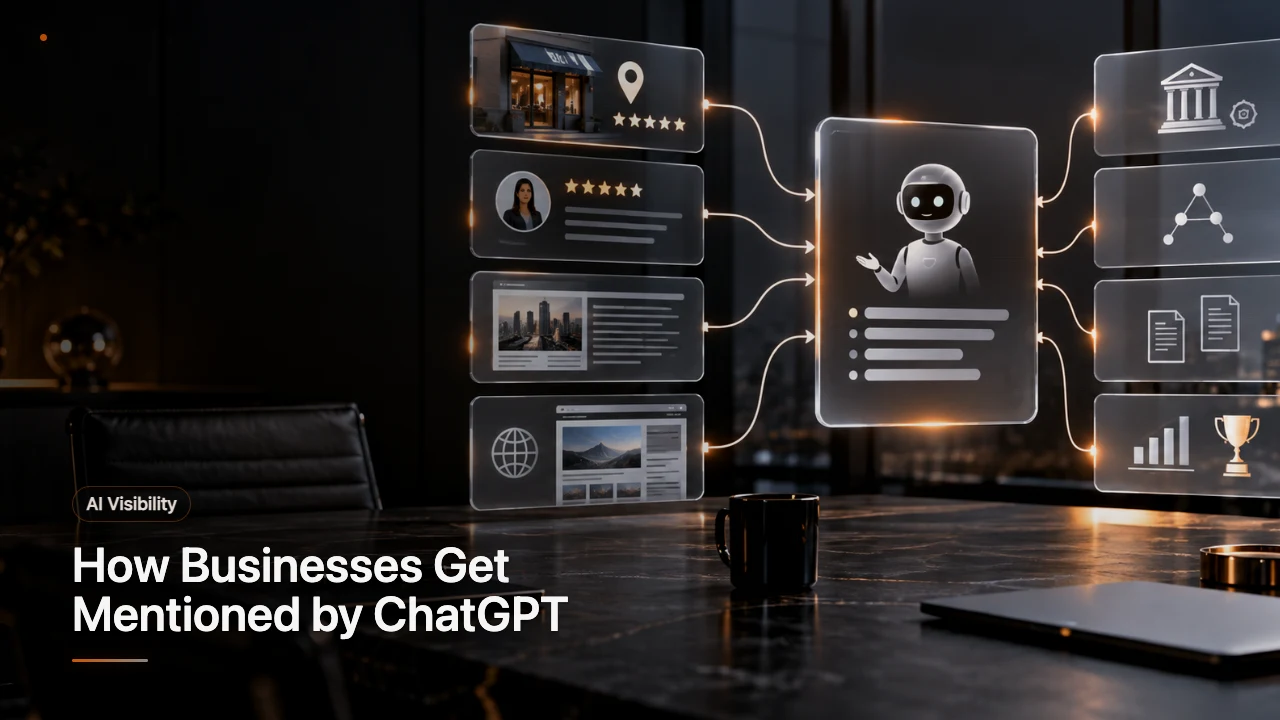
Table of contents
Quick answer
Learn how businesses get mentioned by ChatGPT, what signals matter most, and how to improve citations, entity clarity, content quality, and AI search visibility. This article explains the practical impact for businesses in Pakistan and the decisions to review before investing more budget into ai search optimization or paid growth.
Key takeaways
What you should know before acting
Mentioned vs Cited vs Ranked
How ChatGPT Can Discover Business Information
The Signals That Make a Business Easier to Mention
More businesses are asking the same question now:
Why does ChatGPT mention some brands and ignore others?
It is a fair question, because the buying journey is changing fast.
A potential client may still use Google. But they may also ask ChatGPT who the best providers are, what service they actually need, what a realistic budget looks like, which company sounds credible, or which local business is worth shortlisting.
That means your business can lose visibility before someone ever reaches your homepage.
The uncomfortable part is this: businesses usually do not get mentioned by ChatGPT because of one isolated SEO trick. They get mentioned when their digital presence is easy to access, easy to understand, easy to verify, and useful enough to support an answer.
If your brand is vague, inconsistent, thin, or hard to confirm, ChatGPT has less reason to surface it.
If your brand is clear, trusted, and backed by strong source material, your chances improve.
Introduction
Businesses get mentioned by ChatGPT when the system can confidently connect a brand to a user's question using publicly available, relevant, trustworthy information.
That information can come from your own website, but not only from your own website. It can also be reinforced by category pages, service pages, reviews, local profiles, third-party mentions, structured business details, helpful articles, and other public sources that make your business easier to understand.
In practical terms, ChatGPT mentions tend to follow five conditions:
- your content is accessible to the systems that help power ChatGPT search and retrieval
- your business entity is clearly described
- your pages actually answer useful questions
- the broader web supports your claims
- your business looks like a credible fit for the exact query being asked
This is why "getting mentioned by ChatGPT" is not the same thing as classic ranking.
It sits at the intersection of technical SEO, entity SEO, content strategy, local SEO, digital PR, review signals, and what many teams now call AI search optimization.
This guide explains what that means in plain English, what OpenAI's public guidance makes clear, what Google still contributes to the foundation, and what businesses should do next if they want better visibility in ChatGPT-driven discovery.
The Short Answer
The short answer is this:
ChatGPT is more likely to mention a business when that business is publicly visible, topically relevant, clearly described, supported by reliable signals, and useful to the user's query.
That usually means:
- a crawlable public website
- service pages that explain what the business actually does
- clear brand, founder, category, and location information
- content that answers real questions better than generic competitors
- reviews, citations, and public proof that reinforce trust
- a site structure that makes the business easy to interpret
It usually does not mean:
- stuffing pages with the phrase "ChatGPT search optimization"
- publishing thin AI-written articles at scale
- creating pages with no real audience just to chase fan-out queries
- trying to force mentions through tricks instead of becoming a better source
If you want a simple mental model, use this:
ChatGPT mentions businesses that are easier to verify than their competitors.
Mentioned vs Cited vs Ranked
Many teams mix these together, but they are not identical.
| Outcome | What It Means | Why It Matters |
|---|---|---|
| Ranked | Your page performs in classic search results | Important for discovery and traffic |
| Cited | Your page is directly linked as a source in an AI-assisted answer | Strong proof of relevance and trust |
| Mentioned | Your business name appears as an option, example, recommendation, or brand reference | Influences consideration and shortlist creation |
A business can rank without being mentioned much in AI answers.
A business can be mentioned without dominating classic rankings for every keyword.
A business can also be cited for one topic and never mentioned for another if its entity, proof, or topical coverage is weak.
That is why the right question is not only:
"Do we rank?"
It is also:
"When ChatGPT tries to answer a category question, does our business look like a logical and defensible source or recommendation?"
How ChatGPT Can Discover Business Information
OpenAI's public help documentation gives an important baseline. OpenAI says public websites can appear in ChatGPT search, and it specifically advises publishers not to block OAI-SearchBot if they want their content discovered, surfaced, clearly cited, and linked.
That does not mean every crawlable page will get mentioned.
It does mean visibility starts with access.
At a practical level, business mentions can be influenced by information available through:
- public website pages
- search-accessible content
- pages retrieved in response to live searches
- structured business information on the site
- third-party reviews and profiles
- citations and mentions on other websites
- founder and organization information
- topical articles and guides connected to the business
OpenAI also notes that publishers who allow OAI-SearchBot can track referral traffic from ChatGPT in analytics tools. That matters because it confirms ChatGPT visibility is not an abstract branding idea anymore. It can become a measurable discovery channel.
Google's AI guidance matters too, even though this article is about ChatGPT. Google's current generative search documentation keeps repeating the same foundational truth: unique, helpful content, crawlability, clear technical structure, strong page experience, and content that satisfies people still matter. That foundation makes your site easier for any retrieval-based AI environment to use.
In other words, businesses do not "optimize for ChatGPT" by abandoning SEO.
They optimize for ChatGPT by extending SEO into entity clarity, answer quality, and public trust.
The Signals That Make a Business Easier to Mention
The businesses that get surfaced most often tend to make seven things obvious.
1. Clear Business Identity
ChatGPT needs to understand who you are.
That sounds basic, but many sites still fail here. Their homepage uses vague slogans, their services are unclear, their About page is thin, and their location or category is hard to pin down.
Your site should make these details unambiguous:
- official business name
- primary services
- location or service area
- audience or industries served
- founder or leadership identity where relevant
- what makes the business different
If you are a digital marketing agency in Rawalpindi, say that clearly. If you specialize in local SEO for clinics, say that clearly. If you build custom websites and AI automation systems, say that clearly.
The more precise the entity, the easier it is for AI systems to map your business to the right prompt.
2. Source-Worthy Content
Businesses get mentioned more easily when their content helps answer real questions.
Not every page needs to be a blog post. But some pages should do actual explanatory work.
Strong examples include:
- category explainers
- service comparisons
- local guides
- pricing frameworks
- process breakdowns
- FAQs that reduce confusion
This is one reason posts like [What is AI Search Optimization?](/blog/what-is-ai-search-optimization/) and [AI Visibility Strategy](/blog/ai-visibility-strategy/) matter. They do not only target search traffic. They also build source material that can support future AI answers.
3. Public Trust Signals
If your site says you are an expert but the web offers no supporting evidence, your claim is weaker.
Useful trust signals include:
- consistent business profiles
- review volume and review quality
- client case studies
- references to real locations and industries
- founder profile pages
- mentions in relevant directories or publications
- original examples and practical evidence
Trust signals do not guarantee a ChatGPT mention. But they reduce ambiguity, which is critical.
4. Query Relevance
Businesses do not get mentioned just because they are generally good.
They get mentioned when they look relevant to the exact prompt.
For example:
- A user asks, "Who can help a local clinic with Google Ads in Pakistan?"
- A user asks, "Which agency understands AI search optimization?"
- A user asks, "What should a business in Rawalpindi fix first: SEO, website, or ads?"
Each query implies a different relevance test.
That means your site needs topic-specific pages, not just one broad homepage.
5. Crawl and Index Access
This is the boring part that still breaks visibility.
If pages are blocked, buried, slow, duplicated, or hard to parse, you are creating unnecessary friction. OpenAI's documentation makes crawler access relevant. Google's documentation makes crawlability relevant. That part is not controversial.
What matters:
- important pages return
200 - robots rules do not accidentally block useful content
- the site exposes clean internal links
- the sitemap is current
- content is visible in rendered HTML
- important pages are not orphaned
6. Consistent Entity Reinforcement
The same business should look like the same business everywhere.
If your homepage says one thing, your Google Business Profile says another, your LinkedIn says something else, and third-party listings use different categories, you create confusion.
Consistency should appear across:
- homepage messaging
- About page
- service pages
- contact page
- author or founder pages
- local business listings
- review platforms
- social bios
7. Strong Conversion Context
This is underrated.
Businesses that look legitimate are easier to mention than businesses that look unfinished.
That means:
- obvious contact paths
- real service detail
- proof of work
- clear offers
- updated pages
- professional design and page experience
If the business feels incomplete to a human reviewer, it often feels incomplete to an AI system too.
What OpenAI's Public Guidance Implies for Businesses
OpenAI's publisher guidance does not give a secret formula for being recommended by ChatGPT. It does give enough direction to draw several practical conclusions.
| What OpenAI says publicly | What businesses should infer |
|---|---|
| Public websites can appear in ChatGPT search | You need indexable, public, useful pages |
Do not block OAI-SearchBot if you want discovery and clear citation | Review robots rules and crawler access |
noindex is the right tool if you do not want inclusion | Visibility depends on intentional publishing choices |
| Referral traffic can be tracked in analytics | ChatGPT search is a measurable channel, not just hype |
There is no official "submit my business to ChatGPT" form in that guidance.
There is no promise that schema alone will get you surfaced.
There is no evidence that thin prompt-oriented content beats genuinely useful content.
The best inference is the simplest one:
ChatGPT visibility is earned by being a strong public source, not by begging for inclusion.
The Practical System for Improving ChatGPT Mentions
If a business wants better mention potential, it should work through the following system.
Step 1: Audit Current Mention Visibility
Start by testing the exact kinds of prompts buyers use.
Use category prompts, comparison prompts, local prompts, pricing prompts, and problem-solving prompts.
Examples:
- best digital marketing agency in Rawalpindi
- who can help a clinic get more leads in Islamabad
- how to improve AI search visibility for a local business
- website vs landing page for lead generation
- who offers AI automation for service businesses in Pakistan
Track:
- whether your business is mentioned
- whether your pages are cited
- which competitors appear
- which topics produce zero visibility
- what information AI systems use when they talk about your category
This gives you a real gap map.
Step 2: Fix the Core Entity Pages
Before publishing more blog posts, make your main commercial pages stronger.
Priority pages usually include:
- homepage
- About page
- contact page
- service pages
- location pages where relevant
- founder page
- portfolio or case study pages
Each one should answer:
- who are you
- what do you do
- who do you help
- where do you work
- what proof supports your positioning
Step 3: Publish Topic-Specific Answer Assets
Now create the content that supports mentions.
This content should not be generic thought leadership with no commercial connection. It should help the market understand real decisions.
Good formats:
- "what is" explainers
- comparison pages
- budget guides
- checklists
- local strategy guides
- decision frameworks
These pages are easier for ChatGPT to summarize because they answer explicit questions.
Step 4: Strengthen Third-Party Confirmation
If your business only describes itself on its own site, the signal is weaker.
Build supporting evidence through:
- review generation
- Google Business Profile completeness
- founder visibility
- credible directories
- media mentions where relevant
- case studies with named contexts
- partner or software pages if applicable
The point is not random backlink chasing. The point is corroboration.
Step 5: Improve Structural Clarity
Make your content easier to extract.
That usually means:
- strong headings
- direct answer paragraphs
- comparison tables
- scannable lists
- specific examples
- one clear topic per page
This article itself is structured that way for a reason. If an answer engine needs a quick explanation of how businesses get mentioned by ChatGPT, it should be able to lift the key logic from the page cleanly.
Step 6: Connect Content to Services
Many sites publish decent educational content but fail to connect it back to the commercial entity.
Use internal links to connect topical authority to the service offering.
Examples:
- from AI search articles to your AI search optimization service page
- from local visibility guides to your local SEO offer
- from website strategy posts to your custom website service
Without these bridges, the content may rank or get cited while the business itself remains weak as an entity.
Step 7: Measure and Refresh
This work is not one-and-done.
Track:
- ChatGPT referral traffic where available
- pages cited most often
- pages never surfaced
- branded search growth
- review growth
- local profile engagement
- lead quality from AI-assisted discovery
Then refresh weak pages, add missing comparisons, and deepen the topics that repeatedly matter.
Local Business Examples
This becomes easier to understand with concrete examples.
Example 1: A Dental Clinic in Rawalpindi
If a clinic wants to be mentioned when users ask about local dental marketing or appointment growth, generic content will not do much.
Stronger assets would include:
- a clear clinic service page
- doctor or founder identity
- location-specific pages
- Google Business Profile optimization
- review proof
- content explaining appointment growth, Google Maps visibility, or treatment FAQs
That combination makes the clinic easier to mention in both local and informational prompts.
Example 2: An Architecture Firm in Islamabad
If the website only says "we design beautiful spaces," the entity is too vague.
If the site says:
- custom residential architecture in Islamabad
- portfolio examples
- project process
- target client type
- local experience
- comparison content about builders vs architects
then the firm becomes easier to map to specific questions.
Example 3: A Growth Agency Like CREA8IV MEDIA
For an agency that wants to be mentioned in conversations about AI search, local SEO, paid acquisition, websites, and automation, the path is not to spam every buzzword.
The path is to build a connected content and entity system:
- service pages with clear commercial positioning
- founder credibility
- topical posts like [GEO vs SEO](/blog/geo-vs-seo/), [AEO vs SEO](/blog/aeo-vs-seo/), and [LLMO Explained](/blog/llmo-explained/)
- case studies and category knowledge
- local proof for Pakistan-based businesses
That is how an agency starts to look like a real source, not just another website with opinions.
A 30-60-90 Day Action Plan
First 30 Days
- audit prompts that matter to your business
- review whether
OAI-SearchBotis blocked - improve homepage, About, and top service pages
- fix weak titles, vague copy, and missing trust signals
- ensure key pages are internally linked and in the sitemap
Next 60 Days
- publish 4 to 8 topic-specific articles tied to real buying questions
- add founder or expert profile pages
- improve review acquisition and profile consistency
- tighten local SEO and business citation accuracy
- build one strong comparison page and one pricing or cost page
Next 90 Days
- test mention visibility again across core prompts
- identify which pages get cited or referred
- expand winning topic clusters
- refresh weaker pages with clearer answers and better examples
- connect AI visibility work to lead tracking and conversion review
Mistakes That Reduce Mention Potential
Most businesses do not have a visibility problem because they are small.
They have a visibility problem because their public signals are weak or confusing.
Common mistakes:
- vague homepage copy
- thin service pages
- no founder or expert identity
- blocked or poorly exposed content
- no useful informational content
- inconsistent business descriptions across platforms
- no third-party trust signals
- low-quality AI-generated filler
- chasing volume instead of query usefulness
Google's own generative AI guidance has been blunt about this direction: focus on unique, helpful, non-commodity content and avoid scaled low-value output. That is just as relevant here.
ChatGPT Mention Checklist
- Public site pages return
200and are crawlable robots.txtdoes not blockOAI-SearchBotfrom key public content- Important pages are in
sitemap.xml - The business name, category, services, and location are explicit
- About and contact pages are complete
- Service pages explain outcomes, not just slogans
- Helpful articles answer real questions in your market
- Reviews and public proof reinforce credibility
- Internal links connect informational pages to commercial pages
- The site looks current, trustworthy, and easy to navigate
FAQ
Can I submit my business directly to ChatGPT?
There is no public business-submission form that guarantees inclusion in ChatGPT mentions. The practical route is to make your business publicly accessible, clearly described, useful, and easy to verify across your website and the wider web.
Does blocking OAI-SearchBot affect visibility?
Yes, it can. OpenAI's public publisher guidance says that if you want your content discovered, surfaced, clearly cited, and linked in ChatGPT search, you should not block OAI-SearchBot from the relevant public pages.
Is ranking on Google enough to get mentioned by ChatGPT?
Not always. Traditional SEO helps because it improves discovery and authority, but mentions also depend on answer quality, entity clarity, and supporting trust signals. A ranking page can still be too vague or too weak to deserve mention.
Do reviews help businesses get mentioned by ChatGPT?
They can help indirectly because they strengthen trust, local relevance, and consistency around your business identity. Reviews alone are not the whole system, but they are part of the credibility layer that makes a business easier to trust.
Does schema guarantee ChatGPT mentions?
No. Schema helps clarify structured information, which is useful, but it does not replace good pages, good proof, or crawl access. Think of schema as a support layer, not the main engine.
What type of content makes mentions more likely?
Content that answers real market questions tends to help most: explainers, comparisons, pricing guides, local guides, checklists, and decision frameworks. The best pages are specific, practical, and clearly connected to your actual business expertise.
Conclusion
Businesses get mentioned by ChatGPT when they become easy to understand, easy to verify, and genuinely useful to the question being asked.
That is the real pattern.
Not hacks. Not buzzwords. Not one plugin. Not a fake "ChatGPT ranking trick."
If your business has a crawlable public site, clear entity signals, strong service pages, source-worthy content, review and citation support, and a trustworthy digital footprint, it becomes far easier for AI systems to connect your brand to the right prompt.
That is also why the best AI visibility strategy is rarely separate from good marketing. It is good marketing made more structured, more specific, and more publicly provable.
If you want help building that system, book an AI Search Visibility Audit with [CREA8IV MEDIA](/contact/). We help businesses strengthen their website, entity signals, content architecture, and conversion path so they can be found, trusted, and chosen in both search and AI-assisted discovery.
Execution path
How to use this guide
Audit
Check the current page, search result, and conversion path.Find the exact gaps before changing budgets, copy, design, or publishing frequency.
Fix
Upgrade the offer, structure, tracking, and trust signals.Make the page easier to understand, cite, compare, and act on from mobile.
Scale
Connect the article to Ai Search Optimization.Use the content as a practical entry point into a service, tool, or booked conversation.
Useful links
Continue through the right pages
FAQ
Frequently Asked Questions
Can I submit my business directly to ChatGPT?
There is no public business-submission form that guarantees inclusion in ChatGPT mentions. The practical route is to make your business publicly accessible, clearly described, useful, and easy to verify across your website and the wider web.
Does blocking OAI-SearchBot affect visibility?
Yes, it can. OpenAI's public publisher guidance says that if you want your content discovered, surfaced, clearly cited, and linked in ChatGPT search, you should not block `OAI-SearchBot` from the relevant public pages.
Is ranking on Google enough to get mentioned by ChatGPT?
Not always. Traditional SEO helps because it improves discovery and authority, but mentions also depend on answer quality, entity clarity, and supporting trust signals. A ranking page can still be too vague or too weak to deserve mention.
Do reviews help businesses get mentioned by ChatGPT?
They can help indirectly because they strengthen trust, local relevance, and consistency around your business identity. Reviews alone are not the whole system, but they are part of the credibility layer that makes a business easier to trust.
Does schema guarantee ChatGPT mentions?
No. Schema helps clarify structured information, which is useful, but it does not replace good pages, good proof, or crawl access. Think of schema as a support layer, not the main engine.
What type of content makes mentions more likely?
Content that answers real market questions tends to help most: explainers, comparisons, pricing guides, local guides, checklists, and decision frameworks. The best pages are specific, practical, and clearly connected to your actual business expertise.
What this means for your business
Would a source identify your business without ambiguity?
Make services, location, ownership and evidence clear in public information. Test a small set of relevant questions and record the source links returned.
Mentions vary across systems and sessions. No editorial technique guarantees a recommendation, and a mention is not proof of customer acquisition.
For evaluating discoverability and evidence gaps, explore Syed Qamar Abbas's SEO and AI search consulting.
Editorial decision note added by Crea8iv Media. Founder relationship.
Related Articles