
Web Development
Website vs Landing Page
Compare website vs landing page in 2026 with a practical framework for leads, trust, SEO, speed, and conversion so you choose the right asset for your business.
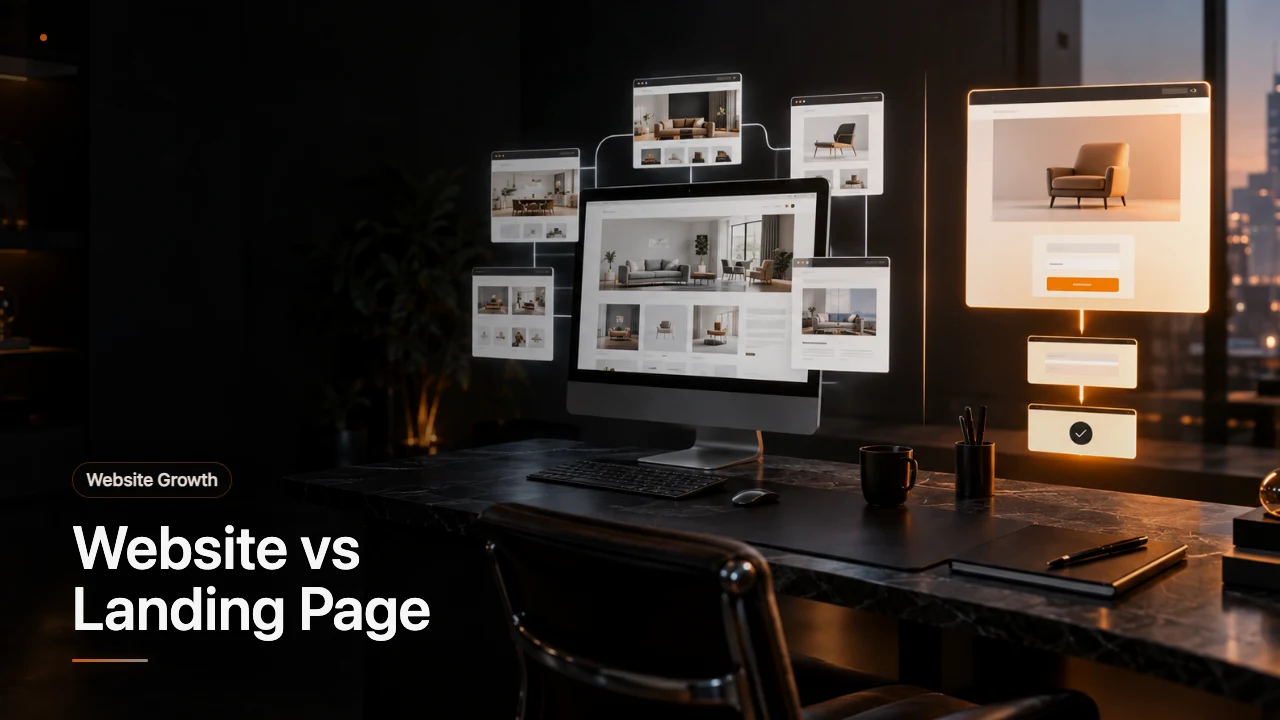
Table of contents
Quick answer
Compare website vs landing page in 2026 with a practical framework for leads, trust, SEO, speed, and conversion so you choose the right asset for your business. This article explains the practical impact for businesses in Pakistan and the decisions to review before investing more budget into web development or paid growth.
Key takeaways
What you should know before acting
What changed in web development and why it matters now
How to turn search visibility into measurable leads
Which actions to prioritize before spending more budget
How Crea8iv Media connects content, tracking, and conversion
A lot of businesses ask the wrong question.
They ask whether they need a website or a landing page, as if one of them is inherently better.
That is usually not the real decision.
The real decision is this:
What exactly are you trying to make a visitor do, and how much context does that visitor need before they will do it?
If you ignore that, you end up with one of two expensive mistakes. Either you build a full website when the campaign really needed a tighter conversion path, or you run ads into a thin landing page when the buyer actually needed proof, credibility, and a broader understanding of the business first.
Both mistakes waste money. They just waste it in different ways.
Introduction
A website and a landing page solve different business problems.
A website is a broader digital home for the business. It gives people room to understand who you are, what you do, what you charge, why they should trust you, and what else you offer. It supports discovery, credibility, SEO, brand positioning, recruiting, investor diligence, referrals, and repeat visits.
A landing page is narrower by design. It exists to move a visitor toward one specific action with as little distraction as possible. It is built around a single offer, one audience, one traffic source, and one main conversion goal.
That is why the argument often becomes messy. Businesses compare two assets that operate at different levels of the customer journey.
One is a system.
The other is a conversion mechanism.
Neither replaces the other perfectly.
In practice:
- a website is better when the visitor needs orientation, trust, depth, and optionality
- a landing page is better when the visitor already has intent and needs a clear path to one action
- many businesses eventually need both working together
This guide explains the difference in plain language, where each one wins, where each one fails, and how to decide what your business should invest in first.
The Short Answer
If you want the fast answer, here it is:
- build a website when your business needs trust, breadth, discoverability, and long-term search value
- build a landing page when you need a focused conversion path for a specific campaign, offer, or audience
- build both when your business is actively marketing and also needs a strong brand presence
The simplest way to think about it is this:
| Asset | Best for | Weakest point |
|---|---|---|
| Website | Trust, SEO, multi-service businesses, research-heavy decisions, referrals | Can dilute attention if every visitor sees too many options |
| Landing page | Paid ads, lead magnets, one offer campaigns, event registrations, quick tests | Often too thin to build deep trust or long-term organic visibility by itself |
If someone searches your brand name, compares your services, checks your credibility, or wants to understand your company, a website usually wins.
If someone clicks an ad for one specific offer and needs a clear next step, a landing page usually wins.
What a Website Does
A website is not just a homepage.
It is the full context layer around the business.
Depending on the company, that can include:
- homepage
- about page
- service pages
- pricing or plan explanation
- case studies
- contact page
- blog or resource hub
- founder or team pages
- legal pages
- career pages
This matters because most buyers do not move in a straight line. They compare. They reopen tabs. They share links internally. They look for proof. They want to know whether the business feels established, competent, reachable, and real.
A strong website helps with all of that.
What a website is good at
| Strength | Why it matters |
|---|---|
| Trust building | Visitors can verify the business through pages, case studies, team details, reviews, and supporting content |
| SEO potential | Multiple pages create more opportunities to rank for service, location, and informational queries |
| Multi-intent traffic | Different visitors can find the page that matches their stage and need |
| Brand control | The business can shape how it presents its expertise, positioning, and process |
| Internal linking | Content can guide readers from education to service pages to consultation |
| Long-term value | A good website keeps compounding instead of expiring with one campaign |
Where a website often underperforms
A website can still fail if it tries to do too much at once.
This is common with businesses that send paid traffic to a general homepage. The visitor clicks because of one promise, then lands on a page with six services, three menu paths, a generic headline, and no clear action.
The website may look professional, but the conversion path is weak.
That is not a website problem.
It is a message-focus problem.
What a Landing Page Does
A landing page is built for concentration.
It usually has one audience, one offer, one CTA, and one path forward. Navigation is reduced or removed. Every section supports the same outcome.
Examples:
- book a consultation
- claim a limited offer
- download a guide
- register for an event
- request a quote
- start a free trial
- schedule a demo
The main job of a landing page is to reduce friction between interest and action.
What a landing page is good at
| Strength | Why it matters |
|---|---|
| Conversion focus | Fewer exits means more attention on the main CTA |
| Message match | The page can mirror the exact promise from an ad, email, or campaign |
| Faster testing | Teams can test offers, headlines, forms, and layouts without restructuring the whole site |
| Campaign clarity | One page can be tailored for one audience or one traffic source |
| Easier measurement | It is easier to attribute leads and diagnose drop-off when the path is narrower |
Where a landing page often underperforms
Landing pages can be too narrow for higher-trust or higher-ticket decisions.
If a clinic is selling a premium treatment, a software company is asking for a booked demo, or an agency is trying to win a serious retainer, some buyers will leave the landing page to check the company anyway.
They want proof beyond the offer:
- who is behind this business?
- what else have they done?
- is this company established?
- what happens after I submit this form?
- are there case studies, pricing signals, or deeper service details?
If the business has no credible website behind the landing page, the conversion ceiling usually stays lower than expected.
Website vs Landing Page: The Real Differences
The easiest way to compare them is by business function rather than design style.
| Decision area | Website | Landing page |
|---|---|---|
| Primary goal | Build trust, explain the business, support multiple journeys | Drive one specific action |
| Typical traffic | Brand search, referrals, organic search, direct visits, social discovery | Paid ads, email campaigns, offers, retargeting, event traffic |
| Navigation | Multi-page, exploratory | Minimal or removed |
| Messaging | Broader and more contextual | Narrow and campaign-specific |
| SEO role | Strong long-term value | Limited unless part of a bigger content system |
| Conversion path | Often several acceptable next steps | Usually one main CTA |
| Measurement | Broader attribution and mixed intent | Cleaner campaign attribution |
| Shelf life | Long-term business asset | Can be short-term or campaign-bound |
Another way to frame it:
- websites help people decide whether they trust the business
- landing pages help people decide whether to take this next step right now
Those are related decisions, but not identical ones.
When a Website Is the Better Choice
A website should usually come first if the business is still missing its core credibility infrastructure.
That is especially true when:
- the business sells multiple services
- the buyer journey involves comparison or research
- the average ticket size is meaningful
- organic search matters
- referrals regularly check the business online before contacting
- the founder, team, or business story affects trust
- the company needs a durable asset rather than a single campaign page
A website is usually the right first investment for:
| Business type | Why a website matters more first |
|---|---|
| Service businesses | Buyers want to understand services, process, proof, and fit |
| Clinics and aesthetic brands | Trust, credentials, treatment explanations, and social proof matter before enquiry |
| Agencies | Case studies, positioning, and service detail strongly influence lead quality |
| Real estate and architecture firms | Portfolio, project type, credibility, and location trust are essential |
| B2B software companies | Product explanation, features, security context, and comparison content matter |
| Local businesses | A website supports brand search, SEO, maps trust, and conversion from multiple channels |
Signs your business needs a website first
- you do not yet have strong service pages
- people ask basic questions your current web presence does not answer
- your business feels hard to verify online
- you want search visibility beyond your brand name
- your offers are too varied for one narrow page
- different audiences need different entry points
If that sounds familiar, a landing page alone will not fix the underlying issue.
When a Landing Page Is the Better Choice
A landing page is the better choice when the traffic has a narrow intent and the offer is already defined.
This commonly applies to:
- Google Ads campaigns
- Meta Ads lead campaigns
- webinar or workshop registrations
- location-specific promotions
- seasonal offers
- lead magnet downloads
- consultation funnels
- one-product launches
A landing page is usually the right first move when:
| Scenario | Why a landing page wins |
|---|---|
| Paid traffic to one offer | The page can match the ad promise exactly and keep the path focused |
| New campaign validation | You can test demand before expanding the full site |
| Short promotion window | A focused page is faster to produce and easier to measure |
| Audience-specific messaging | Different pages can be made for different verticals, services, or pain points |
| Lead-gen with one next step | Forms, trust proof, FAQs, and CTA can all work toward one outcome |
Signs your business needs a landing page now
- your ads are sending visitors to a generic page
- you have one high-priority offer that needs a cleaner funnel
- too many links are distracting users before they convert
- your campaign message does not match the page people land on
- you need fast conversion testing without redesigning the whole website
For a business already running traffic, this can be the highest-leverage short-term fix.
When You Need Both
Most growing businesses eventually need both, because trust and conversion are separate jobs.
The strongest setup often looks like this:
- the website handles trust, discovery, service education, and long-term SEO
- the landing pages handle campaign-specific offers and audience-specific conversion paths
- the two support each other instead of competing
For example:
1. A prospect sees a Google Ad for website redesign services. 2. They land on a focused landing page built around that exact offer. 3. Before submitting, they open the main website in another tab. 4. They check results, pricing context, founder credibility, and broader service quality. 5. They return and convert.
That behavior is normal.
Many businesses assume the landing page failed because the visitor navigated away.
Often the opposite is true. The landing page started the intent, and the website closed the trust gap.
The better question
Instead of asking whether you need a website or a landing page, ask:
- what channel is bringing the visitor?
- how aware is the visitor already?
- how expensive or risky does the decision feel?
- how much explanation does the buyer need?
- what exact action do we want next?
Those answers usually make the decision obvious.
Real Business Examples
Example 1: A local clinic running Google Ads
If the clinic sends ad traffic to the homepage, visitors may have to hunt for the treatment, the doctor details, the before-and-after proof, pricing expectations, and the booking process.
A treatment-specific landing page usually converts better because it keeps all of that context in one path.
But the clinic still needs a solid website, because many buyers will still check:
- about the clinic
- other services
- maps trust
- location
- reviews
- contact details
Best setup: both.
Example 2: A new agency with no real online trust
If the agency only launches one lead form page, prospects may submit poorly or bounce because the business feels thin and generic.
The agency needs:
- a strong homepage
- clear service pages
- founder visibility
- proof of work
- contact credibility
Best setup: website first, then campaign landing pages.
Example 3: A SaaS startup testing one product message
If the startup needs to validate one value proposition quickly, a landing page can be the right first asset. It is faster to test positioning, collect signups, and measure message-market fit.
But once the product matures, the company still needs broader architecture for:
- product details
- comparison pages
- documentation
- pricing
- trust and security
- content marketing
Best setup: landing page first for validation, then website system expansion.
Common Mistakes That Hurt Results
1. Treating the homepage like a campaign page
Homepages serve mixed-intent visitors. They are rarely the best destination for narrowly targeted paid traffic.
2. Treating a landing page like a full brand presence
A landing page can support conversion, but by itself it often cannot support long-term trust, SEO breadth, or business credibility.
3. Sending cold traffic to pages with weak message match
If the ad promises one thing and the page opens with something broader or vaguer, drop-off rises immediately.
4. Overloading the landing page with navigation and multiple offers
At that point, the page stops behaving like a landing page and starts behaving like a weaker website page.
5. Building a website that never tells visitors what to do next
A website still needs conversion architecture:
- visible CTA
- clear forms
- contact paths
- service-specific next steps
- proof close to decision points
6. Ignoring SEO and discoverability entirely
Businesses that rely only on short-term landing pages often trap themselves in permanent paid acquisition. They may generate leads, but they do not build durable search equity or topical authority.
A Simple Decision Framework
Use this framework if you are deciding where to invest first.
| Question | If the answer is yes | Lean toward |
|---|---|---|
| Do visitors need to understand several services or several pages of proof? | They need context and exploration | Website |
| Is this page mainly for one ad campaign or one offer? | The path should stay narrow | Landing page |
| Does organic search matter to growth? | You need more long-term indexed value | Website |
| Is the business already credible but the campaign is underconverting? | You may have a funnel focus problem | Landing page |
| Is the offer high-ticket or trust-sensitive? | Buyers will likely check the business first | Website plus landing page |
| Do you need fast message testing? | Narrow experiments matter more than broad architecture today | Landing page |
A practical rule of thumb
- if your business needs to be understood, build the website
- if your offer needs to be acted on, build the landing page
- if you are serious about growth, connect both
Website vs Landing Page Checklist
Use this checklist before choosing.
Choose a website first if:
- you need a credible online home for the business
- you offer more than one service or solution
- your buyers compare options before contacting
- SEO and discoverability matter
- referrals often research your company before reaching out
- you need case studies, service detail, and company context
Choose a landing page first if:
- you are running a campaign around one offer
- your traffic source is mostly paid or email-driven
- you want one clear CTA with fewer exits
- you need to test messaging or form friction quickly
- your current website is too broad for campaign traffic
Choose both if:
- you are investing in paid traffic and long-term brand growth
- trust matters before conversion
- the buyer journey includes both intent and research
- you want stronger conversion without sacrificing credibility
FAQ
Is a landing page part of a website?
Usually, yes. A landing page often lives on the same domain as the main website, but it behaves differently. It is designed around one focused conversion goal instead of broad site exploration.
Can a business use only a landing page?
Sometimes, but it depends on the offer and the trust requirement. For a simple lead magnet or short campaign, a landing page can work alone. For a serious service business, clinic, SaaS company, or agency, a fuller website usually becomes necessary.
Which is better for SEO: website or landing page?
A website is usually stronger for SEO because it supports multiple indexed pages, internal links, topical depth, and broader search intent coverage. A landing page can rank, but it rarely replaces a full content and service architecture by itself.
Which converts better: a website or a landing page?
For one specific offer and one specific traffic source, a landing page often converts better. For broader trust-building and multi-step decision journeys, the website may be the asset that makes conversion possible in the first place.
Should paid ads go to a homepage?
Usually no. Paid ads generally perform better when they send traffic to a landing page that matches the exact offer and CTA. The homepage can still support trust, but it is rarely the best direct response destination.
What should a good landing page include?
A strong landing page should include a clear headline, one focused promise, persuasive supporting sections, relevant proof, FAQs, a clean CTA, and as little friction as possible between interest and action.
What should a good business website include?
A strong business website should include clear positioning, service pages, trust signals, proof of work, contact paths, and a structure that helps both users and search engines understand the business.
What should a business build first on a limited budget?
If the business lacks credibility online, build the website first. If the business already has trust assets but needs better campaign conversion, build the landing page first. If possible, phase them so the landing pages sit on top of a strong website foundation.
Conclusion
Website versus landing page is not a design debate.
It is a strategy decision.
A website gives your business a durable foundation for trust, discovery, SEO, and brand control.
A landing page gives your campaign a focused path to action.
The mistake is not choosing one over the other.
The mistake is expecting one asset to do the other asset's job.
If your business needs a stronger digital foundation, start with the website.
If your campaign needs sharper conversion, build the landing page.
If you want both credibility and performance, make them work together.
If you want CREA8IV MEDIA to map the right structure for your business, traffic mix, and lead goals, book a website strategy consultation and we will show you whether your next best move is a full website rebuild, a conversion-first landing page system, or a combination of both.
Execution path
How to use this guide
Audit
Check the current page, search result, and conversion path.Find the exact gaps before changing budgets, copy, design, or publishing frequency.
Fix
Upgrade the offer, structure, tracking, and trust signals.Make the page easier to understand, cite, compare, and act on from mobile.
Scale
Connect the article to Website development.Use the content as a practical entry point into a service, tool, or booked conversation.
Useful links
Continue through the right pages
FAQ
Frequently Asked Questions
Is a landing page part of a website?
Usually, yes. A landing page often lives on the same domain as the main website, but it behaves differently. It is designed around one focused conversion goal instead of broad site exploration.
Can a business use only a landing page?
Sometimes, but it depends on the offer and the trust requirement. For a simple lead magnet or short campaign, a landing page can work alone. For a serious service business, clinic, SaaS company, or agency, a fuller website usually becomes necessary.
Which is better for SEO: website or landing page?
A website is usually stronger for SEO because it supports multiple indexed pages, internal links, topical depth, and broader search intent coverage. A landing page can rank, but it rarely replaces a full content and service architecture by itself.
Which converts better: a website or a landing page?
For one specific offer and one specific traffic source, a landing page often converts better. For broader trust-building and multi-step decision journeys, the website may be the asset that makes conversion possible in the first place.
Should paid ads go to a homepage?
Usually no. Paid ads generally perform better when they send traffic to a landing page that matches the exact offer and CTA. The homepage can still support trust, but it is rarely the best direct response destination.
What should a good landing page include?
A strong landing page should include a clear headline, one focused promise, persuasive supporting sections, relevant proof, FAQs, a clean CTA, and as little friction as possible between interest and action.
What should a good business website include?
A strong business website should include clear positioning, service pages, trust signals, proof of work, contact paths, and a structure that helps both users and search engines understand the business.
What should a business build first on a limited budget?
If the business lacks credibility online, build the website first. If the business already has trust assets but needs better campaign conversion, build the landing page first. If possible, phase them so the landing pages sit on top of a strong website foundation.
What this means for your business
Does the visitor need one offer or a broader comparison?
Use a focused destination for a specific campaign decision and a wider site when visitors need to assess services, credibility and company context.
A narrow page may omit information that higher-consideration buyers need. Keep relevant evidence accessible even when the CTA is focused.
Buildscape illustrates a broader service and project website for a considered purchase. It is not an A/B comparison against a landing page. Read the Buildscape case study.
For selecting the destination around customer intent, explore Syed Qamar Abbas's customer acquisition consulting.
Editorial decision note added by Crea8iv Media. Founder relationship.
Related Articles